
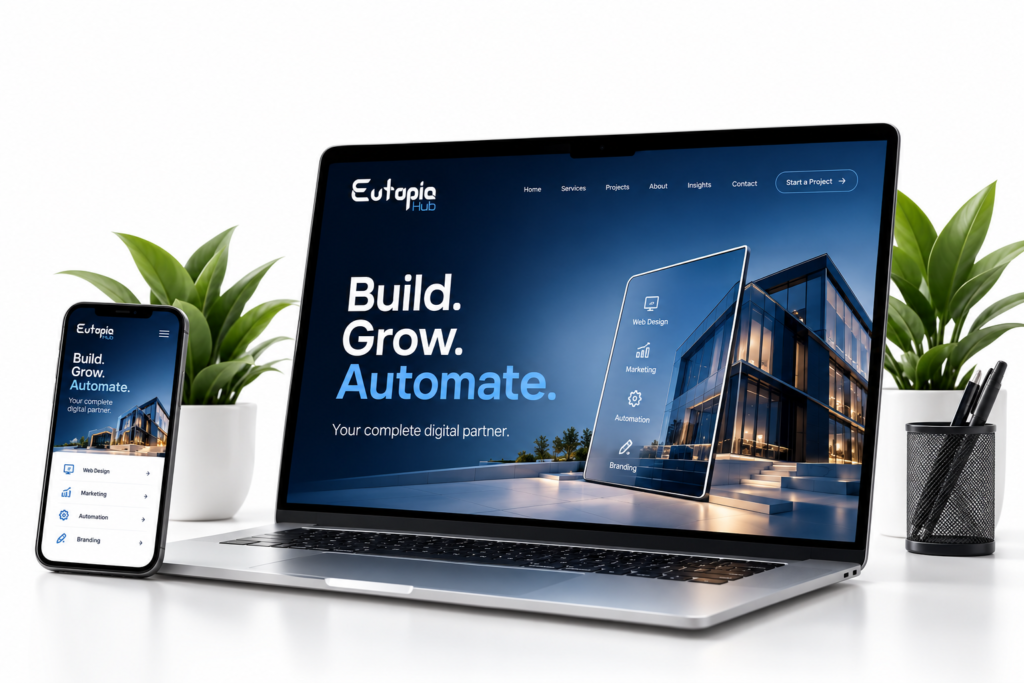
The Future of Modern Web Design Is Faster, Smarter & More Interactive
A great website is no longer defined by how impressive it looks. In 2026, successful digital experiences are built around speed, usability, accessibility, intelligent technology, and clear business objectives.
Today’s visitors expect websites to be visually engaging, easy to navigate, responsive across devices, and genuinely useful. They want to find information quickly, interact without friction, and feel confident in the brands they choose.
For businesses, this creates an opportunity to move beyond traditional web design and build digital platforms that actively support growth.
At Eutopia Hub, we believe the strongest websites combine three essential elements: purposeful design, advanced technology, and a clear strategy.
Here are ten important website design trends shaping digital experiences in 2026 — and how businesses can apply them effectively.
1. AI-Powered User Experiences
Artificial intelligence is changing how businesses interact with website visitors.
Instead of presenting the same experience to everyone, websites can use intelligent tools to provide more relevant content, faster assistance, and personalized recommendations.
AI-powered functionality may include:
- Intelligent chat assistants that answer common customer questions.
- Personalized product recommendations in online stores.
- Automated lead qualification and inquiry routing.
- Smarter on-site search and product discovery.
- Contextual content suggestions based on user interests.
For example, an e-commerce website can help visitors discover products based on their preferences, while a service-based business can use an AI assistant to guide potential customers toward suitable solutions.
However, successful AI integration is not about adding technology for its own sake.
The real value of AI comes from making the customer journey simpler, faster, and more relevant.
Businesses should prioritize accuracy, privacy, and easy access to human support whenever intelligent tools are introduced.

2. Minimalist Design with Maximum Impact
Minimalism continues to influence modern website design, but in 2026, it is about more than white backgrounds and clean typography.
Purposeful minimalism focuses on removing unnecessary distractions while emphasizing the content and actions that matter most.
Common elements include:
- Bold, expressive typography.
- Generous whitespace.
- Clear visual hierarchy.
- Limited, consistent color palettes.
- Simple navigation structures.
- Carefully selected imagery.
- Strong and visible calls to action.
A minimalist website helps visitors understand what a business offers without navigating through unnecessary visual complexity.
Every section should serve a purpose. Every message should communicate something meaningful. Every button should guide visitors toward a logical next step.
Less visual noise creates more room for meaningful communication.
The goal is not to make a website empty. It is to make the experience focused, recognizable, and easy to use.

3. Micro-Interactions and Purposeful Motion
Modern websites are becoming more interactive, creating experiences that respond naturally to user behavior.
Subtle animation and interaction can improve usability by providing feedback, guiding attention, and making navigation feel more intuitive.
Examples include:
- Smooth button hover effects.
- Animated transitions between sections.
- Interactive navigation menus.
- Subtle scroll-triggered elements.
- Visual feedback after form submissions.
- Product previews and interactive galleries.
When applied carefully, these details can make a digital experience feel more polished and engaging.
But excessive motion can slow down a website, distract visitors, and create accessibility challenges.
The most effective approach is to use animation selectively, keeping it lightweight and respecting users who prefer reduced motion.
Great interaction design should improve the experience, not compete with the content.
4. Mobile-First Design and Seamless Navigation
Mobile-first design is no longer an optional consideration. It is a fundamental part of building an effective website.
A responsive layout should do more than shrink desktop content to fit a smaller screen.
It should consider how people actually interact with websites on mobile devices.
Important mobile-first principles include:
- Navigation that is simple and easy to understand.
- Buttons and interactive elements that are comfortable to tap.
- Readable typography without unnecessary zooming.
- Properly optimized images and media.
- Short, accessible forms.
- Clear calls to action.
- Fast loading on mobile networks.
For businesses that rely on inquiries, online purchases, or bookings, mobile usability can directly influence whether visitors complete their intended actions.
A well-designed mobile experience reduces friction and helps customers move confidently from discovery to decision.
The best responsive websites feel intentionally designed for every screen — not adapted as an afterthought.
5. Premium Visual Identity and Authentic Branding
A website is often one of the first meaningful interactions customers have with a business.
Its visual identity should communicate more than style. It should reflect the brand’s character, positioning, and values.
In 2026, strong digital branding increasingly combines:
- Distinctive typography.
- Consistent brand colors.
- Original photography.
- Custom graphic elements.
- Thoughtful layouts.
- Cohesive storytelling.
- Recognizable visual details.
Some premium brands benefit from dark, elegant interfaces and cinematic imagery. Others communicate more effectively through bright, minimalist layouts and subtle design elements.
Neither approach is universally better.
The right visual direction depends on the audience, industry, and brand personality.
A luxury real estate company, for example, may benefit from architectural photography and refined typography, while a technology company may use precise layouts, interactive graphics, and a more contemporary visual language.
The strongest websites don’t simply follow visual trends — they express a clear and recognizable brand identity.
6. Website Performance and Core Web Vitals
A visually impressive website loses value when visitors have to wait for content to appear or struggle with unresponsive interactions.
Performance is an essential part of modern user experience.
Google’s Core Web Vitals provide useful measurements of loading performance, responsiveness, and visual stability.
Three important metrics are:
Largest Contentful Paint (LCP)
Measures how quickly the largest visible content element loads. A good target is 2.5 seconds or less.
Interaction to Next Paint (INP)
Measures responsiveness to user interactions. A good target is 200 milliseconds or less.
Cumulative Layout Shift (CLS)
Measures unexpected movement of page elements. A good target is a score of 0.1 or less.
Practical ways to improve website performance include:
- Compressing and correctly sizing images.
- Using modern image formats where appropriate.
- Minimizing unnecessary scripts and plugins.
- Optimizing hosting and caching.
- Reducing heavy animations.
- Loading nonessential resources only when needed.
- Testing website performance on real devices.
Performance optimization should begin during design and development rather than being treated as a final technical adjustment.
A fast website creates a smoother experience and gives every interaction a better foundation.
7. Custom Illustrations and 3D Visual Experiences
Generic visuals rarely create a memorable digital identity.
More businesses are exploring original design assets that communicate their services, products, and ideas in distinctive ways.
Custom visual elements may include:
- Three-dimensional objects and compositions.
- Branded illustrations.
- Interactive product presentations.
- Custom interface mockups.
- Animated icons.
- Abstract architectural graphics.
- Visual representations of digital workflows.
These elements can help communicate complex services more clearly.
For example, an automation company can use connected 3D modules to demonstrate how different systems work together, while a product-focused business can use interactive models to help visitors understand its offering.
However, custom visuals should support the content rather than overwhelm it.
Heavy 3D experiences are not appropriate for every website, especially when they affect loading performance or mobile usability.
A unique visual experience becomes valuable when it strengthens communication and reinforces the brand.
8. Smart Automation and Connected Business Systems
One of the most significant changes in business websites is their evolving role within daily operations.
A modern website can be much more than an online brochure.
With the right integrations, it can connect directly to the tools and systems a business uses every day.
Common integrations include:
- Customer relationship management systems.
- Online booking and scheduling platforms.
- Email and WhatsApp communication.
- E-commerce and inventory management.
- Lead capture and automated follow-ups.
- Customer and employee portals.
- Payment and invoicing systems.
- Analytics and reporting dashboards.
Consider a service company receiving inquiries through its website.
Instead of manually transferring every request between tools, an integrated workflow can capture the inquiry, organize the customer information, assign the request to the appropriate team, and trigger a follow-up communication.
This can reduce repetitive work and improve operational consistency.
The future-ready website is not an isolated digital asset. It is part of a connected business ecosystem.
9. Accessibility, SEO and User Experience
The best websites are designed to be usable, understandable, and discoverable.
Search engine optimization and accessibility are different disciplines, but both benefit from clear website structure and thoughtful development.
Important practices include:
- Descriptive, logically organized headings.
- Readable and helpful content.
- Meaningful page titles and meta descriptions.
- Accessible navigation and keyboard interactions.
- Descriptive alternative text for informative images.
- Appropriate color contrast.
- Clear link and button labels.
- Structured internal linking.
- Responsive layouts.
- Relevant, well-organized content.
Accessibility should be considered from the beginning of the project.
The Web Content Accessibility Guidelines (WCAG) 2.2 provide a recognized framework for making digital content more accessible to people with different abilities.
Search visibility also requires more than technical optimization.
Google emphasizes content that is useful, reliable, and created primarily to help people.
That means a website should answer genuine customer questions, communicate expertise clearly, and make important information easy to find.
A successful digital experience should work for people first, while giving search engines a clear understanding of its content.
10. Authentic Storytelling and Trust-Driven Design
As digital experiences become more sophisticated, authenticity remains one of the most important ways for businesses to differentiate themselves.
Visitors want to understand who they’re dealing with, what makes a company different, and why its services or products are relevant to them.
Effective websites build credibility through:
- A clear explanation of what the business offers.
- Authentic brand photography and visuals.
- Real portfolio projects.
- Relevant customer testimonials.
- Transparent contact information.
- Clear service descriptions.
- Useful answers to common questions.
- Consistent branding and communication.
For agencies and service providers, detailed project case studies can be especially valuable.
Instead of simply showing finished designs, a case study can explain the business challenge, the approach taken, the work delivered, and any verified outcomes.
This gives potential customers a more complete understanding of the expertise behind the work.
Trust is built through clarity, consistency, and evidence — not visual appearance alone.
How to Choose the Right Website Trends for Your Business
Not every trend belongs on every website.
Before investing in a redesign or introducing new functionality, businesses should identify what they want their website to achieve.
Start by asking:
- What is the primary business goal? Generating leads, increasing sales, building awareness, or simplifying operations?
- Who is the target audience? What information and functionality do visitors actually need?
- What is currently limiting performance? Slow loading, confusing navigation, weak messaging, or disconnected systems?
- Which improvements will create meaningful value? Better usability, stronger branding, automation, or improved content?
- How will success be measured? Qualified inquiries, completed purchases, engagement, or operational efficiency?
The best digital strategy balances innovation with practical business needs.
A small business may benefit more from clearer navigation and faster loading than from advanced animations. An established e-commerce brand may gain greater value from improved product discovery and integrated customer communication.
The right website is not the one with the most features. It’s the one that serves its audience and business goals most effectively.
Final Thoughts: The Future of Web Design Is Connected
Website design in 2026 is moving toward experiences that are more intelligent, more accessible, and more closely connected to the businesses behind them.
AI-powered functionality, purposeful minimalism, responsive interfaces, strong branding, performance optimization, and automation all contribute to this evolution.
But technology alone is not enough.
The most effective websites combine thoughtful strategy with creative execution, technical quality, and a genuine understanding of the customer journey.
Whether you’re launching a new business, modernizing an existing website, or connecting your digital tools, the objective should remain the same:
Create a digital experience that looks exceptional, works effortlessly, and delivers meaningful value.
Build. Grow. Automate.